*/

Review by David Langwallner
Jimmy Stewart, as much as Gregory Peck hitherto referenced in this series, was a personification of old-fashioned American wholesomeness. It’s a Wonderful Life (1946) and Mr Smith Goes to Washington (1939) come to mind but Hitchcock brilliantly cast him in Vertigo (1958) against type where he showed his darker side. Unlike Peck, Stewart was a great actor and in Otto Preminger’s Anatomy of a Murder (1959) is surrounded by a stellar cast of younger method actors. Often regarded as the quintessential trial film, and featuring the legendary Ben Gazzara, Lee Remick and George C Scott as the prosecutor in one of his many portrayals of satanic evil, Stewart out acts everybody playing country bumpkin trial lawyer Paul Biegler. He won the prize in Venice but, though nominated, not the Oscar. It is one of his great performances. Sotte Voce Volcanic.
The film has a real sense of a society in seismic transition, just as now. Duke Ellington and his jazz soundtrack (which won three Grammys) feature heavily in the drama. The content and explicitness of the film caused ructions at the time. Even now, it slightly unsettles. Biegler is down at heel, giving up on the law, fishing every day and drinking far too much in the company of his older alcoholic lawyer friend with an impossibly evocative Irish name Parnell Emmett McCarthy (Arthur O’Connoll). A relationship between older and younger inverted but not unlike that in Sidney Lumet’s The Verdict (1982).
But murder most foul is always an incentive, and Biegler rises to the challenge – not least because the bank account is running dry. A Korean war hero (Ben Gazzara) kills a bar owner who allegedly raped his wife (Lee Remick). It is quite clear that he walked into the bar and shot him equipped. Self-defence is considered by Biegler but in a textbook way dismissed as it was excessive premeditated force in defence of another and if his wife had been raped, he had an alternative – to go to the police. Such matters are frequent occurrences in legal practice. Also, in the defence of duress by modern slavery.
Biegler rediscovers his interest in the law and in a Denningsque way goes to the library (not Lincoln’s Inn), digs up an old law report (think High Trees [1947] KB 130) and comes up with the defence of irresistible impulse. Much of the film is a scholarly disquisition as to whether that is a defence when the defendant, as was accepted, knew the difference between right and wrong (the McNaughten Rules applicable in this jurisdiction) and thus, strictly, insanity cannot apply.
In fact, to address the McNaughten Rules’ rigidity, some US jurisdictions added the ‘irresistible impulse’ test (US v Brawner 471 F.2d 969 (D.C. Cir. 1972)) until the acquittal in 1982 of John Hinckley, who attempted to assassinate President Ronald Reagan, led to elimination of the provision. In this jurisdiction, ‘irresistible impulse’, developed in R v Byrne [1960] 2 QB 396 where Lord Parker CJ broadened the definition of ‘abnormality of mind’, can still be pleaded but only under the defines of diminished responsibility – not the defense of insanity, so it only reduces murder to manslaughter. The defence of derealisation or a disassociated state, also mentioned in Anatomy of a Murder, is quite sceptically regarded in this jurisdiction. Wrongly so in the present universe?
In the film, the practice of interviewing witnesses including the daughter of the deceased, unethical in our system, is at times shocking. It is even in breach of American Bar rules and there is by the prosecution the use of an informant to snitch on the defendant redolent of entrapment and lying under oath. So, the prosecution are complicit in perjury. A crucial core witness for the prosecution is approached by Stewart for the defence, though a field trip reveals surprisingly helpful results. (I have done them myself and recommend it. From Tipperary to Oxfordshire.)
Scott’s, and indeed Stewart’s, in-your-face style of cross-examination is a useful reminder of a corrective to the denudation of robust cross-examination. The graphic exploration of a woman’s sexual behaviour would not meet the gateways today.
At the end of the film, seeking to collect a fee, Biegler finds that the defendant and his wife have left the trailer park with a note: irresistible impulse forced me to leave. So, the acquittal influenced by Stewart’s coaching of the defendant in doubt.
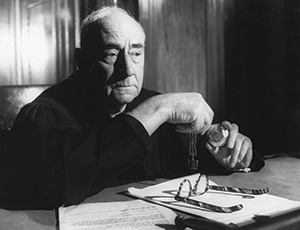
The entire film has the ring then and now of real authenticity. It is based on a book by Michigan Supreme Court Justice John D Voelker (pen name Robert Traver) which dissects a real murder case in which he had been defence lawyer. Joseph N Welch (pictured above), a real-life lawyer who had represented defendants during the McCarthyite era accused of collaboration, takes the role of trial judge in the film.

David Langwallner is a graduate of the Harvard Law School and the London School of Economics. He is a barrister at 1MCB and was 2015 Irish Lawyer of the Year for his work as director of the Irish Innocence Project.
Jimmy Stewart, as much as Gregory Peck hitherto referenced in this series, was a personification of old-fashioned American wholesomeness. It’s a Wonderful Life (1946) and Mr Smith Goes to Washington (1939) come to mind but Hitchcock brilliantly cast him in Vertigo (1958) against type where he showed his darker side. Unlike Peck, Stewart was a great actor and in Otto Preminger’s Anatomy of a Murder (1959) is surrounded by a stellar cast of younger method actors. Often regarded as the quintessential trial film, and featuring the legendary Ben Gazzara, Lee Remick and George C Scott as the prosecutor in one of his many portrayals of satanic evil, Stewart out acts everybody playing country bumpkin trial lawyer Paul Biegler. He won the prize in Venice but, though nominated, not the Oscar. It is one of his great performances. Sotte Voce Volcanic.
The film has a real sense of a society in seismic transition, just as now. Duke Ellington and his jazz soundtrack (which won three Grammys) feature heavily in the drama. The content and explicitness of the film caused ructions at the time. Even now, it slightly unsettles. Biegler is down at heel, giving up on the law, fishing every day and drinking far too much in the company of his older alcoholic lawyer friend with an impossibly evocative Irish name Parnell Emmett McCarthy (Arthur O’Connoll). A relationship between older and younger inverted but not unlike that in Sidney Lumet’s The Verdict (1982).
But murder most foul is always an incentive, and Biegler rises to the challenge – not least because the bank account is running dry. A Korean war hero (Ben Gazzara) kills a bar owner who allegedly raped his wife (Lee Remick). It is quite clear that he walked into the bar and shot him equipped. Self-defence is considered by Biegler but in a textbook way dismissed as it was excessive premeditated force in defence of another and if his wife had been raped, he had an alternative – to go to the police. Such matters are frequent occurrences in legal practice. Also, in the defence of duress by modern slavery.
Biegler rediscovers his interest in the law and in a Denningsque way goes to the library (not Lincoln’s Inn), digs up an old law report (think High Trees [1947] KB 130) and comes up with the defence of irresistible impulse. Much of the film is a scholarly disquisition as to whether that is a defence when the defendant, as was accepted, knew the difference between right and wrong (the McNaughten Rules applicable in this jurisdiction) and thus, strictly, insanity cannot apply.
In fact, to address the McNaughten Rules’ rigidity, some US jurisdictions added the ‘irresistible impulse’ test (US v Brawner 471 F.2d 969 (D.C. Cir. 1972)) until the acquittal in 1982 of John Hinckley, who attempted to assassinate President Ronald Reagan, led to elimination of the provision. In this jurisdiction, ‘irresistible impulse’, developed in R v Byrne [1960] 2 QB 396 where Lord Parker CJ broadened the definition of ‘abnormality of mind’, can still be pleaded but only under the defines of diminished responsibility – not the defense of insanity, so it only reduces murder to manslaughter. The defence of derealisation or a disassociated state, also mentioned in Anatomy of a Murder, is quite sceptically regarded in this jurisdiction. Wrongly so in the present universe?
In the film, the practice of interviewing witnesses including the daughter of the deceased, unethical in our system, is at times shocking. It is even in breach of American Bar rules and there is by the prosecution the use of an informant to snitch on the defendant redolent of entrapment and lying under oath. So, the prosecution are complicit in perjury. A crucial core witness for the prosecution is approached by Stewart for the defence, though a field trip reveals surprisingly helpful results. (I have done them myself and recommend it. From Tipperary to Oxfordshire.)
Scott’s, and indeed Stewart’s, in-your-face style of cross-examination is a useful reminder of a corrective to the denudation of robust cross-examination. The graphic exploration of a woman’s sexual behaviour would not meet the gateways today.
At the end of the film, seeking to collect a fee, Biegler finds that the defendant and his wife have left the trailer park with a note: irresistible impulse forced me to leave. So, the acquittal influenced by Stewart’s coaching of the defendant in doubt.
The entire film has the ring then and now of real authenticity. It is based on a book by Michigan Supreme Court Justice John D Voelker (pen name Robert Traver) which dissects a real murder case in which he had been defence lawyer. Joseph N Welch (pictured above), a real-life lawyer who had represented defendants during the McCarthyite era accused of collaboration, takes the role of trial judge in the film.
Review by David Langwallner


Update from the Chair of the Bar
By Clement Cowley, Partner at The Penny Group
Modernising communication and collaboration at a leading Chancery set. A Zexi case study
How to build profile without compromising professional duties. By Naumaan Farooq, Co-Founder of Inked PR
Marie Law, Director of Toxicology at AlphaBiolabs, examines the role of cut-off levels, and the wider range of factors that must be considered when interpreting results for family court proceedings
Endometriosis Awareness North, a charity raising awareness of endometriosis and supporting those affected across the North of England, has received a £500 boost from AlphaBiolabs via the company’s Giving Back initiative
A decade of reviews and research has disrupted accepted thinking in the search for causality. Suicides following abuse have overtaken domestic homicides. Is the law keeping up? Professor Susan Edwards KC (Hon) examines recent cases and the obstacles to successful prosecution
The case against judge-only justice – and why efficiency is not enough. By Professor Leslie Thomas KC
Heritage as an anchor and a compass, finding our common humanity and embracing the power of the outsider – Melina Antoniadis’s lessons learnt
Seeing the full picture – Baljit Ubhey OBE outlines the CPS action plan to tackle violence against women and girls, offering insights directly relevant to courtroom practice
Lauren Fullerton examines the how, what and why of setting up a second chambers base